
Knox County VINELink Coverage
Ohio VINELink is the public entry to Ohio VINE. State material says the network receives custody information from ODRC, the Department of Youth Services, and participating county jails. That structure matters in Knox County. A local jail booking must be matched to the Knox County jail source, while a person conveyed to an Ohio prison must be matched to ODRC. The reporting agency shown on a VINE record identifies which custody event the status concerns.
VINE serves two functions. It lets a person search for a specific custody record, and it accepts registration for alerts by phone, text, email, or TTY where offered. It is not the legal custodian of the booking, release, or court order. A VINE status is data supplied through an agency feed. An alert can give prompt notice, but the Knox County Jail, the relevant court, or ODRC remains the source for the underlying release record.
| Custody | VINE route | Proof source |
|---|---|---|
| Knox County Jail | Ohio VINE participating county-jail record | Jail Division, Records Division, and court |
| Ohio state prison | Ohio VINE record reported through ODRC | ODRC Offender Search and ODRC records |
| Federal sentence | Not covered as BOP custody | BOP Inmate Locator and federal case record |
| Immigration detention | Not an ICE locator | ICE Online Detainee Locator and ERO |
Ohio VINE also publishes the assistance number 1-800-770-0192 in current state registration material. Availability in a broad network does not mean each agency sends every field or keeps a released record searchable for the same length of time.
Coverage also follows a person across distinct stages. A Knox County jail record can end when the sheriff reports a transfer into state custody. The later prison record is an ODRC event, even though both concern the same person. If the person eventually enters APA supervision, that status describes release from prison with continuing state oversight. Read each event with its named agency and date. Combining separate feeds into one vague “released” conclusion can hide a transfer, an ongoing sentence, or active supervision.
Search Knox County VINELink Records
Search one person at a time. Begin at the Ohio entry, then choose the offender search and the relevant agency or facility scope if the live interface asks for one. Name spelling and custody system are critical. A person released from Knox County Jail may have a local booking identifier, while a state prisoner has an ODRC number. A federal register number belongs in BOP, not VINE.
- Open the Ohio service. Use the official Ohio VINELink entry and select offender search.
- Choose the custody scope. Select the agency or facility tied to the person's Knox County jail booking or Ohio state-prison record when prompted.
- Enter the best identifier. Search with first and last name or an offender or booking identifier. Try lawful spelling variants if the first search fails.
- Resolve multiple matches. Compare age or date of birth, gender, agency, facility, and ID before opening a record.
- Read the event and source. Note current custody status, reporting agency, location when shown, and the event date and time for a reported release.
- Corroborate the result. Confirm a local event with the jail and court, or a state event with ODRC.
A no-result does not prove release. It may stem from an alias, spelling difference, wrong custody system, data-feed delay, transfer, agency nonparticipation, or a released record that is no longer searchable. The broader Knox County released-inmate verification path shows how the current jail list, local courts, Records Division, and ODRC fit together when VINE returns no match.
The official Ohio VINELink search landing page provides the interface captured below.
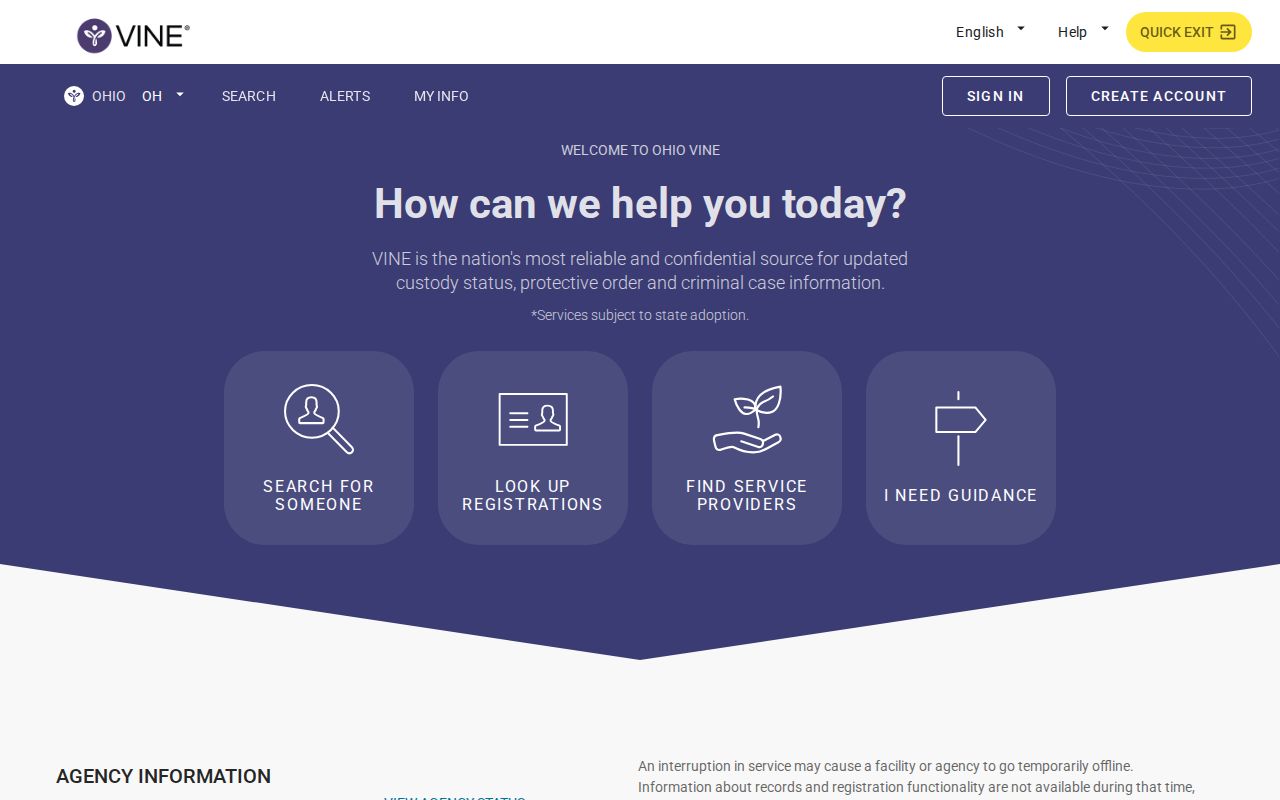
The screen is an entry point, not a Knox County release record. The selected agency and matched person determine what any later result means.
Note: Save the check date and reporting agency because a screenshot without that context can later be mistaken for a current custody status.
Knox County VINE Release Fields
Output varies by participating agency and its data feed. Typical VINE fields identify the person and state the current status, location, or supervising agency. A released event may include a supplied event date and time. Read the exact words on the live record. A location can identify the reporting custodian, not the person's current home, and an event time should be checked against the agency source when the precise departure matters.
| Field | What it establishes |
|---|---|
| Name and offender or booking ID | Helps distinguish the record from a namesake when compared with other identifiers. |
| Custody status | Reports the status supplied by the participating agency at the time of the feed. |
| Agency or facility | Shows whether the event concerns county-jail custody or an ODRC source. |
| Location or supervising agency | Shows the responsible custodial or supervision source when the feed supplies it. |
| Status-change date or time | Dates the reported release, transfer, or other event, but still needs source confirmation. |
“Released” means departure from the reporting custodian. It does not always mean unrestricted return to the community. A person may leave on bond, enter APA supervision, report to local probation, move to another jail, or enter federal or immigration custody. Match the agency first. Then ask whether the event was a community release or a transfer.
Register Knox County Release Alerts
Notification registration begins after the correct person record is open. The current button may read Register for Notifications or Get Notified. Choose a delivery channel that can be checked reliably, enter it twice when the form requests confirmation, and finish the verification step. Never place another person's private phone number or email into a registration without authority.
- Open the matched record. Recheck the name, ID, age or birth information, and reporting agency before registering.
- Select the alert control. Choose Register for Notifications or Get Notified, depending on the wording displayed.
- Choose delivery. Select phone, text, email, or TTY where available, then enter and confirm the destination.
- Complete verification. For telephone notices, create the requested four-digit PIN. When the automated call arrives, enter the PIN, generally followed by the pound key, to confirm receipt and stop repeat calls.
- Save the confirmation. Keep the registration record and update the contact information if it changes.
Email, text, and account registration use the confirmation displayed by the live interface. A successful registration proves only that the request was accepted. It does not promise instant delivery. Keep the confirmation and maintain a direct agency contact when timing matters.
The VINELink state-selection and registration entry shows the channel used to reach Ohio and begin the alert process.
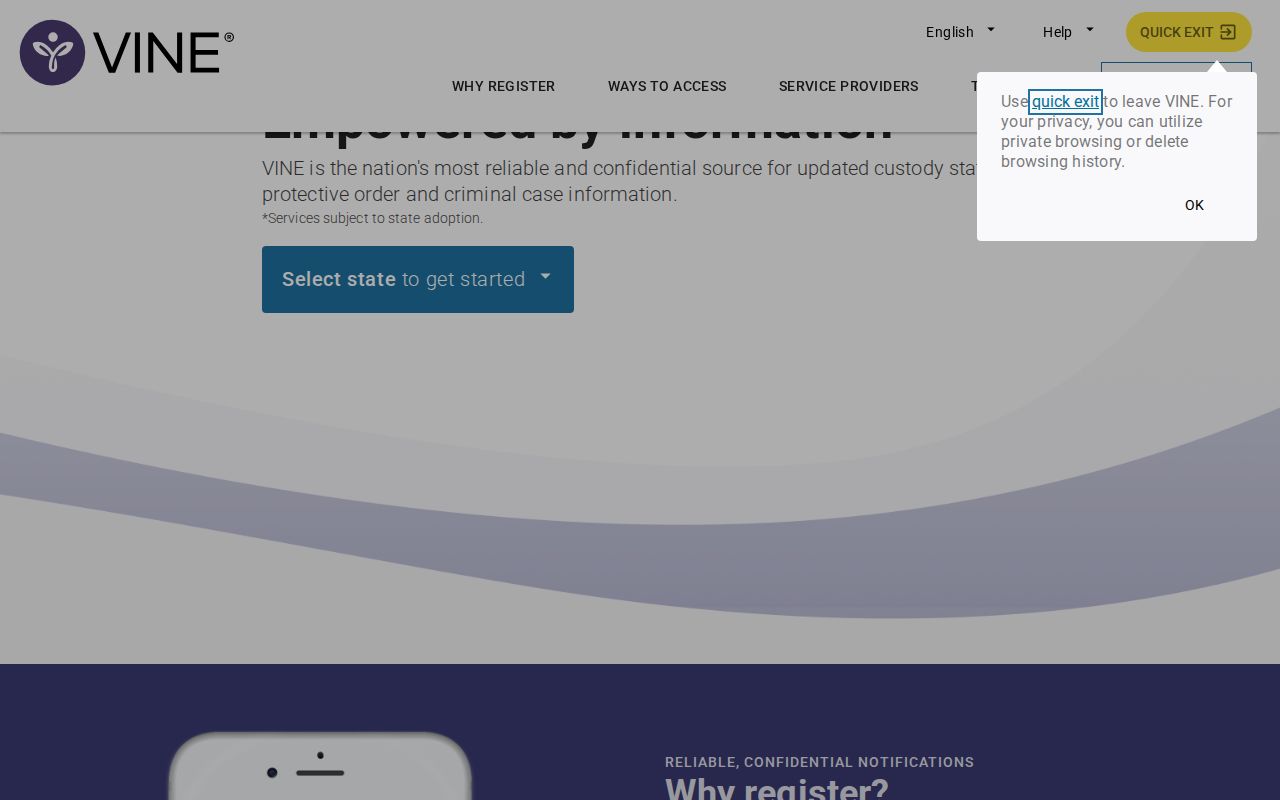
This registration entry routes the request to the selected state. It does not identify a person until the user completes a matched offender search.
Confirm Knox County VINE Releases
A Knox County Jail alert should be checked against local records. Call the Jail Division at 740-399-3940 and ask whether the named person remains in custody. If not, ask for the recorded release date and time and whether the departure was a community release or an agency transfer. For documentary proof, contact the Knox County Sheriff's Records Division and request the identified booking and release record.
The court explains legal authority. Common Pleas CourtView handles felony and general-division matters, while Mount Vernon Municipal Court has a separate case search for matters within its jurisdiction. Review bond, dismissal, sentence, jail-time credit, community-control, and conveyance entries. A court order can explain why release was authorized, while the jail record establishes the actual physical departure.
For an ODRC alert, open the person in the state Offender Search. Compare county of commitment, offense, ODRC number, current status, institution or APA office, and release detail. If the page still says incarcerated or presents a future expected date, a VINE alert may concern another change rather than completed state-prison release.
Knox County VINELink Limits
VINE is optimized for custody status and timely notifications, not permanent historical retrieval. Participating agencies control the source data. Status updates can lag. Released records may cease to be searchable, and fields can differ between the Knox County Jail and ODRC. These limits make VINE useful as a signal, but not as sole proof when a legal deadline or safety decision depends on release.
Important: Treat every VINE alert as supplemental notice and confirm the event with the reporting jail, court, or ODRC record.
VINE does not cover a federal sentence as BOP custody. A person housed at Knox County Jail on a federal pretrial matter may also be under U.S. Marshals Service authority and may never have entered BOP. For a sentenced federal prisoner, use the BOP Inmate Locator. For a fact-supported immigration transfer, use ICE's locator. A no-result in VINE cannot answer either question.
Registries are also separate. Ohio's sex-offender search applies only to people with a statutory registration duty. It is not a broad release list. Its presence or absence cannot replace the Knox County release record, VINE event, or ODRC status.
Note: A status can be accurate for one custodian while saying nothing about a hold or transfer imposed by another agency.
Knox County Custody Source Match
The best VINE check begins before the name search. Identify which system likely held the person. A short local stay, bond event, misdemeanor sentence, or dismissal points to the Knox County Jail and local courts. A felony prison commitment points to ODRC. A federal sentence points to BOP. A possible immigration transfer points to ICE only when the case facts support it. Searching every system without a custody basis creates false matches.
Stable identifiers reduce that risk. Use a jail booking identifier for a local episode, an ODRC number for a state record, a federal register number for BOP, or an A-number for ICE. Court case numbers help connect the legal order to the custodial event. Repeat bookings require special care because a historic VINE release event does not prove the person remains out today, and a later booking does not erase the earlier release.
A simple sequence keeps the conclusion narrow: identify custodian, match the person, read the event, verify with the source. That sequence preserves VINE's value without asking it to function as a court order or permanent archive.