
Knox County ODRC Releases
The Ohio Department of Rehabilitation and Correction operates Ohio's adult state prisons. No ODRC prison was identified as physically located in Knox County. A Knox County defendant sentenced to prison first leaves the county jail through a conveyance or transfer. ODRC then controls placement, and that institution can change. The county of conviction does not predict one permanent prison.
Disappearance from the Knox County Jail PDF at conveyance does not mean freedom. The court's sentencing or conveyance entry and ODRC admission show continuity of custody. A later ODRC status, release detail, and date document prison departure. If the record moves to APA Supervision, the person has left prison but remains under the Adult Parole Authority. Final discharge is a later and distinct event.
The Knox County released inmate search covers local jail, state prison, court, and conditional federal paths. For a known Ohio prison sentence, however, the statewide ODRC record is the direct route.
Search ODRC Release Records
The ODRC Offender Search permits a direct offender-number lookup or name and status filters. The status choices include All, Incarcerated, Released, APA Supervision, and Violators at Large. Use the exact ODRC number when available because a name alone can return several people.
- Enter the ODRC number, or search by last and first name. Number instructions use an A, R, or W prefix with six digits and no spaces or hyphens.
- Choose Released for a completed prison stay, APA Supervision for a person believed to have left prison under state supervision, or All when the status is uncertain.
- Open the full detail. Do not rely on the result row.
- Match the photograph, ODRC number, committing county, docket and judge, admitted date, offenses, and sentence information.
- Record the current status, institution or APA office, release-related date, and Parole or Release Detail with the date searched.
Some female W numbers require a leading zero. Not every detail includes every field, and ODRC warns that sentence information may be incomplete. A matching photograph is helpful but not sufficient by itself. County of commitment, docket, sentence, and stable identifiers should all point to the same person.
ODRC State Offender Search
The official Ohio offender search form is the statewide entry point for Knox County defendants who entered state-prison custody. The captured interface below shows the source that should be used instead of the county's current jail roster.
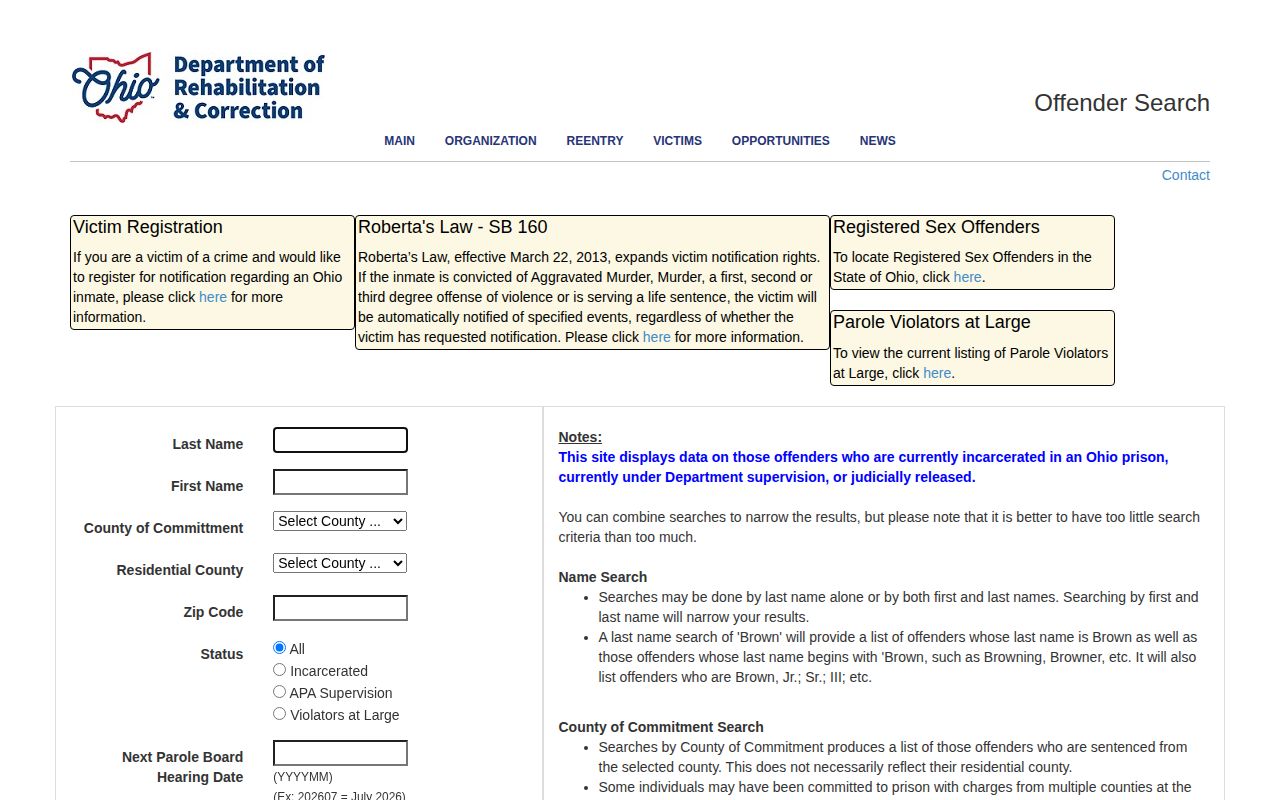
The form's status choices let a search distinguish incarceration, a released result, and APA supervision. Opening the detail is still required because the row cannot establish the complete sentence, county match, release mechanism, or continuing supervision.
Read ODRC Release Status
ODRC labels carry precise meanings. They should not be collapsed into “out” or “not in jail.” The table below separates prison custody, prison release, supervision, and final discharge.
| ODRC field or status | What it supports |
|---|---|
| Incarcerated | The person remains in ODRC prison custody at the listed institution or status point. |
| Released | The state-prison custody event has ended under the displayed release detail; read the complete record. |
| APA Supervision | The person has left prison and is under Adult Parole Authority supervision. |
| Violator at Large | An APA absconder status, not a verified current address or authority for a private person to act. |
| Parole or Release Detail | The released or paroled mechanism when populated; it can be blank for someone still incarcerated. |
| Discharge | The end of the controlling custody or supervision relationship, which may occur after prison release. |
“Judicial Release” means the sentencing court released the person to community supervision. The court journal remains the best source for the operative order. “APA Supervision” does not mean the sentence and all state oversight ended. Likewise, a last reported address is not a promise of current residence, and data may lag a move.
Note: A Violator at Large label does not supply a known location, and law enforcement must verify any warrant through official law-enforcement systems.
ODRC Expected Release Dates
The exact public label is “Expected Release Date/Parole Eligibility Date.” It combines two concepts that must be read carefully. A projected release date can change with sentence calculations and later events. Parole eligibility means a person may be considered for parole; it is not a scheduled departure.
ODRC's definitions also use POA Date for “parole on or after” and PRD for Projected Release Date. The earliest possible date can move because of corrected jail-time credit, sentence aggregation, court changes, earned-credit awards or withdrawals, disciplinary action, detainers, parole decisions, or an indefinite-term review. A date passing on the calendar does not prove release. Reopen the current detail and read Status plus Parole or Release Detail.
Projected is not completed: Confirm actual ODRC release through current status and release detail, not by waiting for an expected date to pass.
Ohio does not have a universal “85% rule.” Current earned-credit law has a 15 percent aggregate ceiling for eligible program and activity credit under Ohio Revised Code 2967.194, but exclusions, mandatory terms, sentence type, offense and sentence dates, participation, discipline, indefinite-term law, and court action prevent one blanket formula.
ODRC Release to APA
The Adult Parole Authority administers state parole and post-release control. To verify that a released Knox County state prisoner remains supervised, set the ODRC search status to APA Supervision and inspect Supervision Start Date, Period of Supervision, APA Offices, displayed conditions, and Residential County or ZIP. These fields support an ongoing state relationship, not a final discharge.
State supervision is different from Knox County probation or community control. A person released from the county jail under a local Common Pleas order may report to Knox County Adult Court Services instead of APA. Mount Vernon Municipal Court also has its own probation operation for cases in its jurisdiction. Determine the sentencing court and whether the person served an ODRC prison term before choosing an office.
The APA field-services information routes questions to the responsible state unit. The institution that last held a person is not necessarily the office supervising the release. Placement and supervision assignments can both change.
Request ODRC Release Records
Start with the public offender detail. If it does not settle an older release, identify the person by ODRC number and ask ODRC Central Records for existing, releasable records. Ohio Revised Code 5120.21 requires ODRC to maintain entrance, transfer, and discharge information, including the date, cause, and terms of discharge. The full institutional record is generally restricted, but the statute permits disclosure of specified categories such as name, convictions, photograph, supervision status, current and past incarceration locations, and disciplinary history.
ODRC Central Records
P.O. Box 430
Columbus, OH 43216
Ohio Department of Rehabilitation and Correction
Request the release or discharge fields that matter: ODRC number, date and mechanism of release, past institution, supervision status, and the releasable terms of discharge. Acknowledge that Ohio Revised Code 5120.21 and the Public Records Act can limit parts of the file. Do not demand confidential medical, security, victim, parole-proceeding, or institutional material.
A judicial-release order comes from the sentencing court. APA supplies public supervision status. The ODRC record supplies state custody and release data. Combining those custodians is appropriate when each is kept within its role.
Knox Jail to ODRC
The Knox County Jail is a local full-service jail, while ODRC institutions are state prisons for people committed under Ohio sentences. The county roster is not the way to confirm a later state-prison release. Conversely, ODRC does not ordinarily cover someone who merely posted bond, finished a local misdemeanor jail term, or had a local charge dismissed unless that person also has an ODRC history.
When a Knox court orders conveyance, match the sentencing entry to the ODRC admission. The Knox disappearance then means transfer. Later, use Released or APA Supervision in the state system to identify prison departure. This sequence keeps two separate release events from being merged: the county's transfer out and the state's later release.
- County departure
- Knox County physical custody ends, often by conveyance to an ODRC reception process.
- State placement
- ODRC assigns and may later move the person among institutions.
- Prison release
- ODRC incarceration ends under the recorded release mechanism.
- Final discharge
- State custody or supervision ends after any required APA period.
No adult state prison was identified inside Knox County. Use the official ODRC facilities directory for current placement context rather than assuming one institution from the county of conviction.