
Knox County Projected Versus Actual Release
A projected date is a calculation made before the person leaves custody. It can reflect the imposed sentence, jail-time credit, sentence structure, earned credit that has actually been awarded, and later decisions. ODRC uses the exact combined label “Expected Release Date/Parole Eligibility Date.” That label can describe either a projected release date or a date when parole consideration may occur. It is not a promise that the person will walk out on that date.
An actual release is a completed event. For a Knox County Jail stay, the Sheriff's release record should give the physical departure date and time, legal authority, and transfer destination when applicable. For a state-prison term, current ODRC Status and Parole or Release Detail help establish that prison custody ended. A future date that later passes does not prove release. Reopen the record and read its current status.
Scheduled versus actual: A future date is a planning field. Confirm departure through a released status, release detail, or the custodian's completed release record.
Pretrial detention is different. A person awaiting a Knox County court decision may leave after bond, recognizance, dismissal, or another order, but no fixed sentence-expiration date exists. Another warrant or agency hold can prevent departure even after one case permits release. The court supplies authority; the jail supplies the actual exit record.
- Projected Release Date (PRD)
- A prospective sentence calculation that can change before release.
- Parole Eligibility Date
- A date when an eligible case may be considered, not a guaranteed release date.
- POA Date
- Parole on or after, the earliest date for release to APA supervision.
- Discharge
- The end of a custodial or supervision relationship, depending on the record's context.
Find Knox County Projected Release Dates
Choose the route by custody. The ODRC Offender Search covers a Knox County defendant who entered Ohio prison custody. It does not calculate a date for someone who merely bonded out of the Knox County Jail, served a local misdemeanor term, or had a local charge dismissed. Those events stay with the sheriff and the relevant court unless the person also has a separate ODRC history.
- Identify the case and custodian. Decide whether the person is pretrial, serving a county-jail sentence, or serving an Ohio prison term.
- For state prison, search ODRC. Use the exact offender number when known, or search by first and last name and filter the status.
- Open the full detail. Match the photograph, county of commitment, docket, judge, offense, admitted date, and sentence to avoid a namesake error.
- Read the exact label. Record “Expected Release Date/Parole Eligibility Date,” current Status, Aggregate Sentence, Jail Time Credit, and Parole or Release Detail when shown.
- For county custody, read the judgment. Use the correct Knox County court docket for the imposed term, jail-time credit, concurrent or consecutive terms, and later orders.
- Confirm the calculation. Ask the Jail Division or sentencing court about a local term. Recheck ODRC for a state term and preserve the date of the online observation.
The Knox County release-record workflow supplies the local court and sheriff channels when the inquiry concerns a jail episode rather than state prison. Common Pleas CourtView covers felony and general-division matters. Mount Vernon Municipal Court maintains a separate search for matters in its jurisdiction.
The public ODRC example detail below shows the combined expected-release and parole-eligibility label in context.
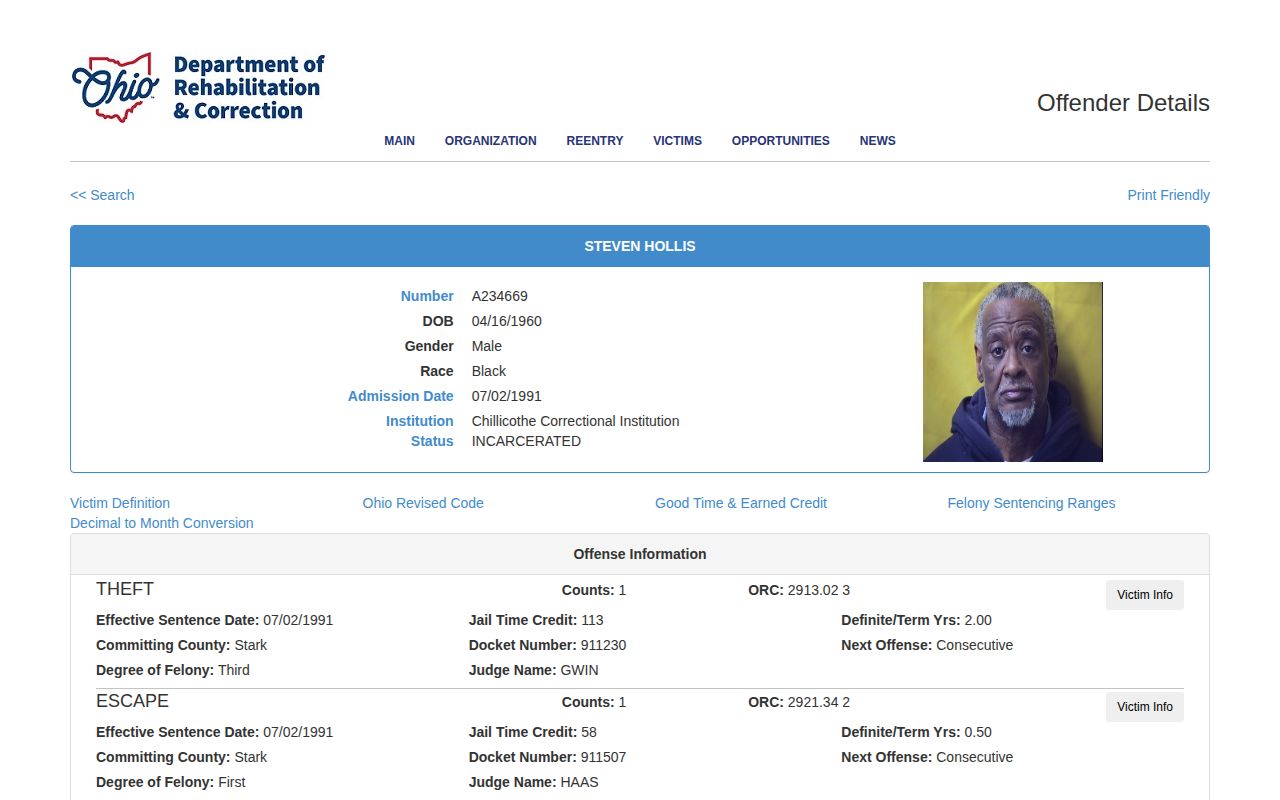
The surrounding status, sentence, and hearing fields are essential. Extracting the date alone can turn an eligibility marker into a false release promise.
Note: Record the date of every ODRC check because a future calculation can be revised after the screenshot or note was made.
Knox County ODRC Date Fields
ODRC details can include Admission Date, current or former Institution, Status, offenses, Effective Sentence Date, Jail Time Credit, Committing County, Docket Number, Judge, Aggregate Sentence, and release-related dates. Not all records show every field. ODRC also cautions that sentence information may be incomplete, so the court judgment and any later entries remain important.
| ODRC field | How to read it |
|---|---|
| Expected Release Date/Parole Eligibility Date | Prospective release calculation or parole consideration date, depending on the sentence. |
| Status | Shows whether the person is incarcerated, released, under APA supervision, or in another listed state status. |
| Jail Time Credit | Credit reported toward the sentence calculation; corrections may alter the math. |
| Aggregate Sentence | Combined sentence information that must be read with mandatory, definite, indefinite, or life components. |
| Parole or Release Detail | Release mechanism detail for a released or paroled record; it can be blank for an incarcerated person. |
| Supervision Start Date | Supports release into APA supervision, not the end of the full state relationship. |
A Released status can be more useful than an old projected date. The ODRC released-result example captured below retains a release status, release mechanism, photograph, and the same date label.
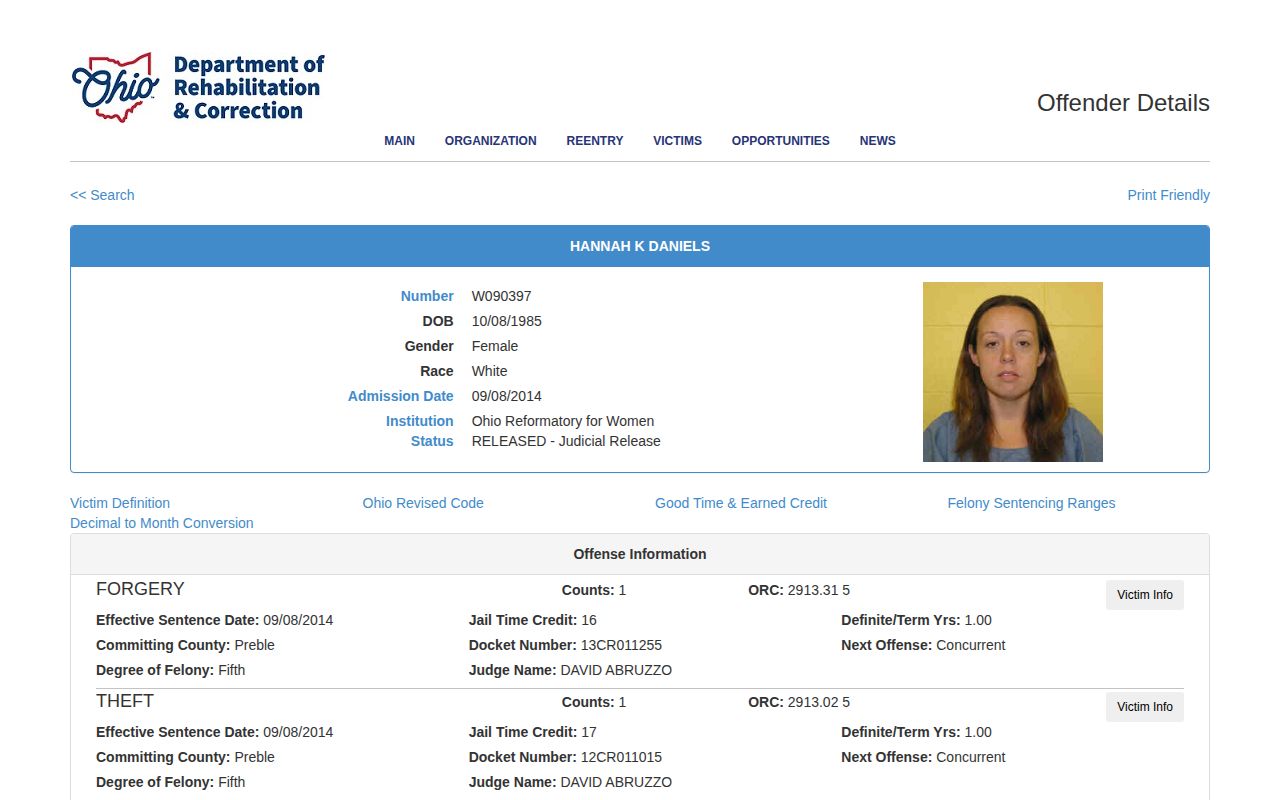
This example demonstrates how a completed status changes the reading. The operative court journal remains the strongest source for the judicial-release order itself.
Knox County Earned Release Credit
Ohio does not have one universal “85% rule” for every prison sentence. Current earned-credit law has a 15% aggregate ceiling for eligible program and activity credit. That ceiling can make some eligible stated terms look like an 85-percent minimum, but it is not a formula that applies to all people or all sentence parts. Offense type, sentence date, mandatory time, definite or indefinite structure, jail-time credit, program completion, discipline, and court or board action all matter.
The central current statute is Ohio Revised Code 2967.194, applicable beginning April 4, 2024. An eligible person may provisionally earn one or five days for each completed month of productive participation in listed ODRC programs. Up to five more days may be available for a second qualifying program or activity. Credit can be denied or withdrawn for rule violations and is finalized through administrative review. The aggregate program and activity credit limit is 15% of the total stated term.
Exclusions are substantial. They include death, aggravated murder or murder and related forms, certain life-without-parole or special terms, and specified sexually oriented offenses based on offense date. Some older sexually oriented sentences have a different statutory rule. Certain completions can yield 90 days or 10% of the stated term, whichever is less, subject to exclusions. The transition statute is ORC 2967.193, and administrative implementation appears in OAC 5120-2-06.
Credit is earned through eligible participation and agency review. It should not be subtracted from a Knox County sentence as soon as the term is read on the docket. Only credit actually awarded belongs in a current projected calculation.
Knox County Indefinite Sentence Dates
Non-life felony indefinite terms require another layer. Ohio Revised Code 2967.271 creates a release presumption tied to the minimum or presumptive earned early release date for qualifying terms, but it also permits continued incarceration through the statute's procedures. The minimum term is therefore not always the actual release date.
Parole-eligible sentences also resist a single calculation. Eligibility means the board may consider release. It does not mean release must occur. ODRC's combined date label is designed to cover these different sentence paths, which is why the record must be read with hearing data, POA or PRD, Status, and the aggregate sentence.
Life without parole is never parole eligible. Other life categories and specified full-year terms follow the eligibility rules in ORC 2967.13. A favorable hearing result can still lead to a future on-or-after date or later action. Never convert an eligibility month or favorable label into an immediate physical-release statement.
Why Knox County Release Dates Change
Projected dates move when one of the inputs changes or when a later authority acts. Some changes shorten the estimate. Others extend custody or replace release with transfer. The current court and corrections records control, even when an older saved result displays a different date.
| Factor | Possible effect | Where to check |
|---|---|---|
| Corrected jail-time credit | Moves the computation after the credited days are changed | Court entry and ODRC detail |
| Concurrent or consecutive terms | Changes how multiple terms are aggregated | Sentencing journal and Aggregate Sentence |
| Earned program credit | Can move an eligible date earlier once awarded | Current ODRC computation |
| Disciplinary action | Can cause provisional credit to be denied or withdrawn | ODRC administrative record |
| Modified or vacated judgment | Changes the legal sentence being computed | Current court journal |
| Parole or judicial release action | Can create a release path or a later review date | ODRC detail and court or board record |
| Detainer or other hold | Can lead to transfer or continued custody after one term ends | Custodian and the agency that lodged the hold |
A detainer is a notice that another authority may claim custody. It can mean the person leaves the current facility but does not return to the community. Likewise, a court-ordered ODRC conveyance ends the Knox County Jail stay yet begins state custody. A release date must always identify which custodian it concerns.
Note: A past projected date with an incarcerated status calls for a fresh record check, not an assumption that the agency missed the release.
Knox County Jail Sentence Dates
County-jail computation is separate from ODRC prison credit. A Knox County misdemeanor term follows the sentencing entry, jail-time credit, concurrent or consecutive directions, and any controlling local or state rule. Research did not identify a published Knox County Jail good-time formula or a weekend-release policy. Applying the ODRC 15% credit ceiling to a local jail term would be unsupported.
Read the complete judgment, not just “time served” in a short docket line. Another count, case, capias, warrant, or agency hold can control. Ask the sentencing court and Jail Division for the calculation used in that episode. If the predicted date matters, request the present calculation and its inputs. After departure, request the actual release date and time, legal authority or release type, and destination or transfer agency.
A person held before trial has no sentence calculation to project. Bond posted on one case can authorize release while a second hold prevents it. The jail record is needed to establish whether staff completed a community release.
Confirm Knox County Release Dates
For state prison, reopen ODRC and read current Status, institution, Parole or Release Detail, and supervision fields. APA Supervision supports that the person left prison into state supervision. Released with Judicial Release should be paired with the court journal that ordered it. When an older record is unclear, identify the ODRC number in a narrow Central Records request and ask for existing, releasable discharge or supervision information.
For county custody, call the Knox County Jail Division at 740-399-3940 or use the Sheriff's Records Division. Ask whether the person was released to the community or transferred and request the actual date, time, authority, and destination. Pair that response with the correct Common Pleas or Municipal Court record.
Ohio VINELink release alerts can provide notice of a reported custody change, but the alert remains supplemental. Automated notices can lag, and “released” refers to departure from the reporting custodian. Confirm the event through the jail, ODRC, or court before treating the projected date as complete.