
Knox County Release Meanings
A Knox County release record must answer more than whether a name vanished from a list. It should identify the person, the custody that ended, the time of departure, and the authority or destination. The official Knox County Jail Inmate List is a current-custody PDF. It is not a history of Knox County released inmates. A missing name can reflect community release, a move to another jail, state-prison conveyance, a federal transfer, or a data change. The jail record supplies the event, while the court order often explains why it occurred.
Release also has several legal meanings. Bond or recognizance ends detention on one case while the case continues. Time served means the custodial part of a sentence has been credited as complete. A dismissal may remove one hold, but another warrant can still control. Parole and post-release control move a person from prison to supervision. Probation, often called community control in Ohio, is court supervision that may follow a local jail release. A transfer ends one agency's custody without granting freedom. Discharge is usually later and can mean supervision itself has ended.
- Bond or recognizance
- Release from detention while the case remains open, subject to the court's terms.
- Time served
- Credit that completes the custodial term imposed in the relevant judgment.
- Parole
- Release from a parole-eligible prison term under Adult Parole Authority supervision.
- Probation
- Court-run community supervision, also called community control in many Ohio case records.
- Transfer
- A handoff to another custodian rather than a return to the community.
- Discharge
- The end of custody or supervision, depending on the record and agency using the term.
Knox County Release Record Fields
A useful Knox County Jail record ties the release to a specific booking episode. This matters when one person has more than one stay. The identifying side can include full name, booking or jail number, commitment date, case number, and birth information when it is lawfully available. The event side should show when jail staff ended physical custody and what authority controlled that act. Ohio jail rule OAC 5120:1-8-01 requires full-service jails to document reception and release procedures.
| Field | What it shows |
|---|---|
| Name and stable ID | Links the event to the right person and booking, not merely a similar name. |
| Commitment date and case | Identifies the jail stay and the court matter that led to custody. |
| Release date and time | Records the actual end of the jail's physical custody. |
| Release authority or type | May identify bond, recognizance, time served, dismissal, sentence end, parole, or court order. |
| Destination agency | Separates a community release from transfer to ODRC, another jail, federal authority, or immigration custody. |
| Supervision status | Shows whether parole, post-release control, probation, or another term may follow departure. |
A court journal and jail timestamp serve different roles. A bond, sentencing, dismissal, community-control, or transport order explains the legal basis. It may not record the minute the person walked out. The jail timestamp can prove departure, yet it may give little detail about the case that follows. Knox County released inmates are best verified by matching both records, including the case and booking episode.
Note: Online roster visibility and the county's legal retention of a booking or release record are separate matters.
Knox County Release Turnover
The Knox County Sheriff's 2022 Annual Report gives local turnover context, but its labels must stay intact. It reports 1,114 “total prisoners housed” in 2022, made up of 854 men and 260 women. The figure fell from 2,070 in 2018. These are not proven counts of unique people, bookings, or Knox County releases. The same report lists 136 inmate transport orders to or from prisons and rehabilitation facilities in 2022, which shows why departures cannot all be called community releases.
Those figures describe workload and movement, not an online release feed. A transport can lead to a prison, treatment site, hospital, or another detention setting. For a named person, the jail release record must still state the destination. The annual report supports the need for that check; it cannot replace it.
Request Knox County Release Records
The Knox County Sheriff's Records Division is the direct local custodian for a past booking and release record. The Records Clerk line is 740-399-3904, and the Sheriff's main number is 740-397-3333. The jail is at 11540 Upper Gilchrist Road, Mount Vernon, OH 43050. Ask for existing records from one identified episode. A narrow request is easier to locate and less likely to return only the current roster.
- Give the person's full name and approximate booking date. Add a case, booking, or jail number when known.
- Request the booking and release record, actual release date and time, release type or legal authority, transfer destination, and booking photograph if needed.
- Cite Ohio Revised Code 149.43 and ask for an electronic copy. A requester generally does not need to explain the purpose of the request.
- Ask staff to advise of any cost in advance and to cite the legal basis for any denial or redaction.
- Compare the response with the correct court journal. If the person was transferred, continue in the receiving agency's system.
Ohio law requires a public office to make records available for inspection and copying within a reasonable period. The law does not set one fixed response time for every request. Written wording helps preserve the scope. If a request is unclear or too broad, the office may offer a revision. An electronic request can also avoid paper copy charges.
The Records Division's current contact and fee display can be viewed at its official source page.
The captured office page connects the historical release request to the county unit that holds the source record.
Knox County Release Fees
Two sets of charges can appear near Knox County release research, and they apply to different events. The Jail Division says sentenced inmates booked into and released from the jail are assessed a $20 processing fee under its reimbursement policy. The jail says it deducts that amount from commissary. It does not describe payment as a condition that must be met before physical release.
Records copy costs are separate. The Sheriff's Records Division lists no charge for 1 through 19 black-and-white pages, then $0.15 per page at 20 or more. It lists no charge for 1 through 9 color pages, then $0.25 per page at 10 or more. A CD is $2, a DVD is $3, and a USB drive is $10. Emailed copies have no listed copy charge. Postage or large storage costs may apply, prepayment can be required, and payment is by check or money order rather than cash.
Does the $20 jail fee prove release? No. It is a published reimbursement charge for sentenced inmates, not a release certificate or a substitute for the booking and release record.
Sealed Knox County Release Records
Ohio sealing and expungement can change what a Knox County released inmate search returns. Ohio Revised Code Chapter 2953 governs the framework, while ORC 2953.31 defines official records broadly enough to include court references, law-enforcement material, fingerprints, and photographs. Sealing restricts ordinary public access. Expungement has its own statutory meaning. Neither should be reduced to the loose claim that every trace is erased.
A missing docket or booking hit after a court order may reflect a lawful access change. It is not proof that the arrest, jail stay, or release never occurred. Current eligibility and waiting rules depend on the case and the version of the law that applies. The correct path is the court's present process. Juvenile records have an added confidentiality boundary and should never be inferred from adult inmate tools.
Note: Respect a sealed result and use the issuing court's process for questions about lawful access or correction.
Knox County Release Laws
ORC 149.43 governs Ohio public-record inspection and copying, but it also contains exceptions. Medical material, defined confidential investigatory material, juvenile records, sealed records, and some probation or parole proceeding records can be restricted. Access is assessed field by field. A public booking fact does not make a whole jail file open.
State-prison records use a distinct rule. ORC 5120.21 requires ODRC to maintain entrance, transfer, and discharge information. Much of an institutional file remains confidential, yet the statute permits disclosure of categories such as name, convictions, photograph, supervision status, current or past incarceration locations, and disciplinary history. That balance explains why the Ohio offender page provides useful release data without opening the complete prison file.
Find Knox County Released Inmates
Choose the system from the custody the person actually left. A short local jail stay belongs with the Sheriff and the sentencing court. A felony prison term belongs with ODRC. A federal sentence belongs with BOP. A factually supported immigration transfer belongs with ICE. Searching every database at random raises the risk of a namesake match and can blur release with transfer.
- Open the dated Knox County jail PDF. A listed name suggests current county custody, while an absent name calls for proof from another source.
- Search both local court paths. Common Pleas CourtView covers felony and general-division matters; Mount Vernon Municipal Court covers matters in its own jurisdiction.
- Call the Jail Division at 740-399-3940 or request the actual booking and release record from the Records Division.
- If the court ordered state conveyance, search ODRC and match the offender number, committing county, docket, offense, and sentence.
- Use Ohio VINELink for a custody-change notice, then confirm the alert with the reporting jail, ODRC, or court.
- Use BOP, USMS, or ICE only when the case or recorded destination supports that federal path.
Stable identifiers reduce false matches. Record the jail booking number, ODRC number, federal register number, A-number, or court case number as the system permits. Compare the booking or admission date, county, charge, age, and source timestamp. A later booking does not erase an older release. Likewise, an old released status does not establish where the person is now.
Note: Save the date of every roster or portal check because operational status can change after a screenshot is made.
Knox County Release Search
The ODRC Offender Search is the main path for a person conveyed from Knox County to an Ohio prison. It supports name and offender-number searching. Status choices include All, Incarcerated, Released, APA Supervision, and Violators at Large. ODRC numbers use A, R, or W followed by six digits, with no spaces or hyphens; some W numbers require a leading zero. This search does not cover someone who merely bonded out of Knox County Jail or completed a local misdemeanor term.
| Search field | How to use it | Identity check |
|---|---|---|
| Last and first name | Choose Released or APA Supervision when checking a past prison stay. | Compare photo, committing county, offense, and dates. |
| ODRC number | Enter the exact prefixed six-digit number. | This is stronger than a name-only match. |
| Status | Separate Incarcerated, Released, APA Supervision, or Violator at Large. | Read the full detail, not only the result row. |
| Hearing month | Use YYYYMM for the next Parole Board hearing search. | A hearing or eligibility date is not a release date. |
The detail can show admission date, institution, status, offenses, jail-time credit, committing county, docket number, judge, aggregate sentence, and “Expected Release Date/Parole Eligibility Date.” That combined label is prospective. It is not proof of departure. A released or paroled record may add Parole or Release Detail, while APA Supervision means the person left prison but remains under state supervision.
The official ODRC form and results view can be checked at the state offender-search source.
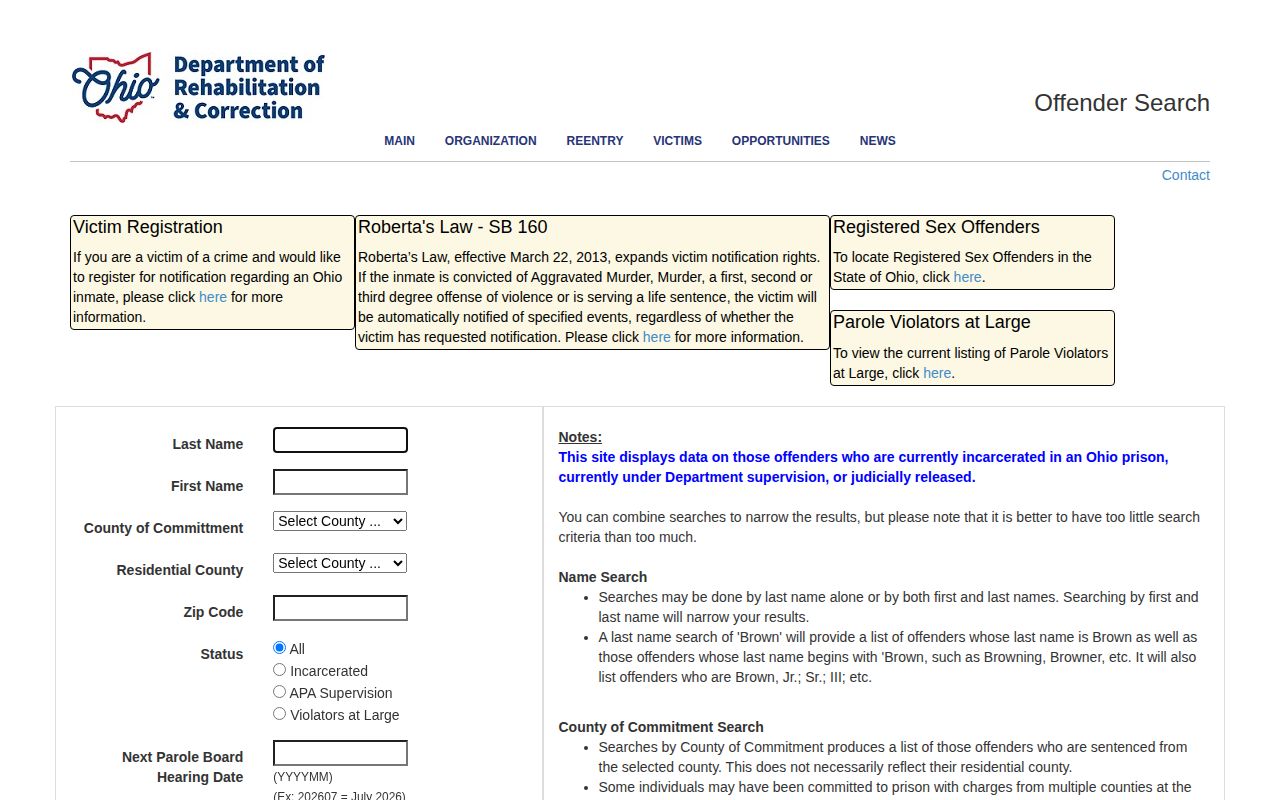
The captured search screen shows the statewide route used after a Knox County court sends a person into ODRC custody.
Knox County Release Court Orders
Knox County has two distinct online court paths. Common Pleas CourtView is the felony and general-division source. The Mount Vernon Municipal Court case search covers misdemeanors, traffic cases, and preliminary felony matters within its jurisdiction. When the charge level is uncertain, search both. A felony bound over from Municipal Court continues in Common Pleas.
Read the filed journal entry, not just a terse event label. Bond posted, dismissal, time served, community control, ODRC conveyance, judicial release, and probation termination all have different effects. “Case closed” is only a docket status. Bond release can coexist with a pending prosecution, and one hold can remain after another charge ends. The court order explains authority, while the Sheriff record gives the actual departure time and destination.
The two local systems are easy to distinguish in the source images. The Common Pleas CourtView landing page is shown below.
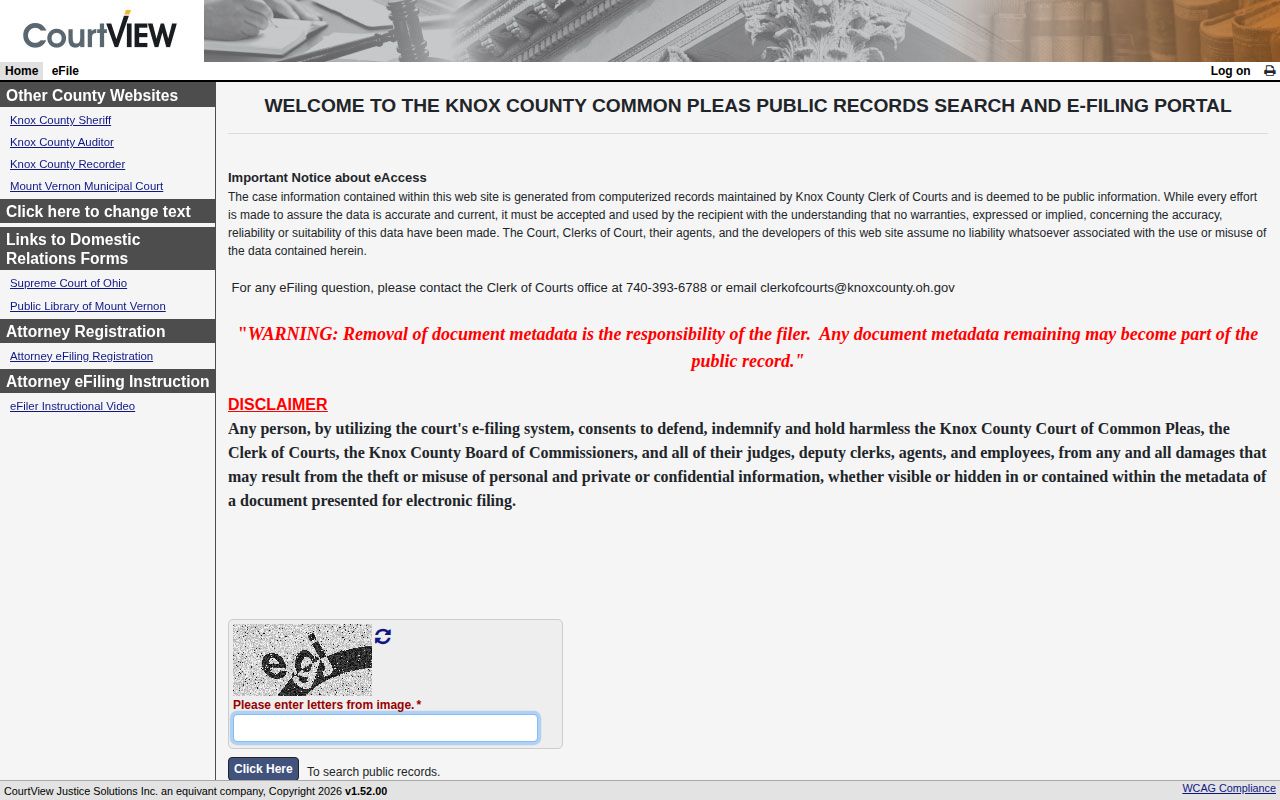
Its case chronology can explain a Knox County release, but jail confirmation remains necessary when the physical exit time matters.
Knox County Release Reentry
Local navigation after release depends on the supervising authority. Knox County Common Pleas Adult Court Services lists a Re-Entry Officer alongside probation staff. That office can be relevant when a sentencing court orders community control. A person released from an Ohio prison may instead report through ODRC's Adult Parole Authority. The court case and ODRC status identify which agency controls.
The Freedom Center Criminal Justice Services describes jail referrals, assessment, counseling, groups, and case management in work with the Sheriff and both local courts. It is a service route, not an inmate-status database. Its involvement does not prove release or supervision. Verify the Knox County release first, then use the proper agency or service contact for the next step.
Old Knox County Release Addresses
The current Sheriff's Office and 100-bed Knox County Jail opened on Upper Gilchrist Road in 2002. It replaced the roughly ninety-year-old Chestnut Street jail, which was later demolished for courthouse parking. The Sheriff's history explains that move. Old directories can still point toward downtown, so the historic address should not be used for a current release-record request or jail-status call.
Current contact details belong to the official county pages. The live Jail Division lists 11540 Upper Gilchrist Road and 740-399-3940. The Records Division has a separate clerk line for documents. Distinguishing those channels avoids sending a request to the former jail site or treating an old number as present authority.
Knox County Federal Release Transfers
The Sheriff's annual report says Knox County Jail houses federally charged prisoners under a U.S. Marshals Service contract. That makes federal-custody ambiguity a local concern. A pretrial USMS detainee can appear on the Knox roster without ever becoming a sentenced BOP prisoner. If that name disappears, the person may have moved to another federal contract bed instead of leaving custody.
Use the federal court detention or release order and the USMS prisoner process first for a pretrial federal case. BOP becomes the better source after commitment to a federal sentence. Its locator covers federal inmates released from 1982 onward and updates daily. A past Release Date with no facility, or a Location of RELEASED, means the person is no longer in BOP custody. It does not prove that supervision ended or that another agency did not assume custody.
Verify Knox County Release Results
Searches for “Knox County 24 hour inmates” often return Knox County, Tennessee. Those results describe a different sheriff and jail system. An Ohio source uses the county's .oh.us domain, refers to Mount Vernon, and commonly uses the 740 telephone area code. Knoxville and 865 numbers point to Tennessee. These simple checks prevent a false claim that Knox County, Ohio publishes a 24-hour product.
Ohio's Sheriff publishes a current Jail Inmate List PDF, not an official 24-hour or 72-hour release feed. No public refresh promise or post-release display period was found. Comparing copies and listing names that disappeared would create an unsupported release list. A roster change should instead trigger a jail call, a records request, and a review of the correct Ohio court.
Note: The official Ohio county domain and Mount Vernon location are the fastest checks against out-of-state search contamination.
Knox County Release Alerts
Ohio VINELink can search a specific person and register a custody-change notice from a participating agency feed. Search within the right jail or state-prison scope, match available identifiers, and save the event time and reporting agency. A no-result is not proof of release. Spelling, aliases, feed delay, transfer, nonparticipation, or a record that is no longer searchable can all affect the result. An alert is a prompt to confirm with the jail, court, or ODRC.
For a sentenced federal prisoner, use the BOP Inmate Locator. ICE's Online Detainee Locator is appropriate only when a detainer or transfer is supported by facts. It searches by A-number and country of birth, or by biographical details, and is mainly a current-location tool. No official evidence identifies Knox County Jail as an ICE detention facility. A transfer into ICE custody is not community release.
Narrow Ohio registries can add context for the people they legally cover, but they are not broad released-inmate lists. The state sex-offender search applies only to a statutory registration population. Its absence says nothing about most Knox County released inmates.
Compare Knox County Release Sources
Each public tool answers a different question. The most reliable Knox County released inmate lookup uses the source that created the status and then checks the related court or receiving agency. A current roster cannot supply a past release record, and a state or federal release does not prove that all supervision or other custody has ended.
| Source | What it can establish | Key limit |
|---|---|---|
| Knox jail PDF | A person appears on the dated current-custody list. | Absence does not prove release or show a destination. |
| Sheriff release record | Actual jail departure time, authority, and recorded destination. | May need a direct public-record request. |
| Knox court journal | Bond, sentence, dismissal, community control, or transfer authority. | May not show the physical exit time or another hold. |
| ODRC Offender Search | Ohio prison incarceration, release, APA supervision, and related dates. | Does not cover an ordinary county-jail release. |
| VINELink | Agency-fed custody status and change notices. | Feed coverage and timing vary; verify at the source. |
| BOP or ICE locator | Federal prison status or possible current immigration detention. | Neither is a routine Knox County jail-release source. |
When two sources conflict, verify the event with the office that created it. Use the case and stable identifier to explain the mismatch.
Knox County Release Facilities
The county and outside systems below have distinct records. The Knox County Jail is the primary adult local facility. Juvenile matters follow the authorized Juvenile Court process and do not belong in an adult search. Ohio prisons, BOP institutions, and ICE custody are separate state or federal pathways; none was identified as a prison or ICE detention center physically located in Knox County.
- Knox County Jail: verify a local community release or transfer through Jail Division, Records Division, and the proper court.
- Knox County Juvenile Probation/Detention pathway: restricted youth information is handled through Juvenile Court's authorized process.
- Ohio Department of Rehabilitation and Correction institutions: verify state-prison placement, release, discharge, or APA supervision through ODRC.
- Federal Bureau of Prisons institutions: use BOP for a sentenced federal prisoner and interpret a past federal release date narrowly.
- ICE detention system: use the locator only when a supported immigration transfer is at issue.
Start with the first agency that held the person. Follow the documented destination, not a guess. That chain preserves the difference between Knox County released inmates who returned to the community and people whose custody simply changed hands.